
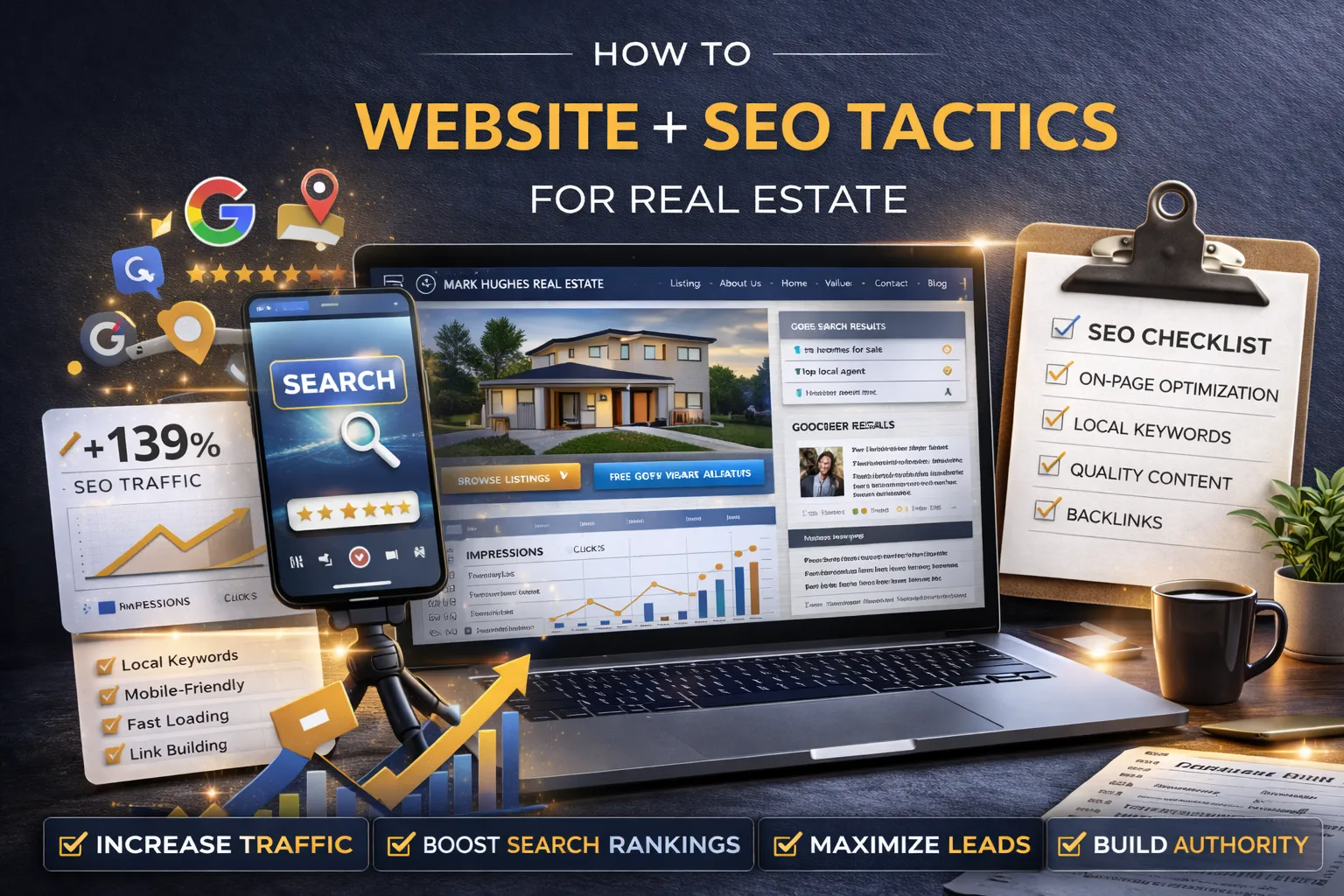
Website and SEO Tactics for Real Estate Agents
Your website is the only piece of online real estate you actually own. Social media platforms change algorithms, portals control your visibility, and paid ads disappear the moment you stop paying. Your website is the one asset that works for you around the clock, on your terms, for as long as you maintain it.
Yet most agent websites are little more than a digital business card: a headshot, a phone number, and an IDX feed that looks identical to every other agent’s site in the market. This produces almost no organic traffic, captures almost no leads, and gives potential clients no reason to choose you over the agent whose site they visited 30 seconds earlier.
This guide covers the website elements that actually generate business, the local SEO tactics that drive organic traffic, and the technical basics you need to get right without becoming a web developer.
What Your Website Needs to Do
An effective real estate website serves three functions: it establishes your credibility, it captures leads, and it ranks in search results. Every page on your site should contribute to at least one of these goals.
Establish credibility. Your About page, testimonials, recent sales, and market expertise content all tell visitors that you are a real professional who knows the local market. Credibility is built in the first 5 seconds a visitor spends on your site.
Capture leads. Every page should offer a clear next step: a free home valuation, a GBP audit, a neighborhood guide download, a consultation booking, or at minimum a visible phone number and contact form. If someone visits your site and leaves without a way to continue the conversation, you lost a potential client.
Rank in search. Your site needs to appear when people in your area search for real estate information. This requires content that targets the specific questions buyers and sellers are asking about your local market.
The Pages That Matter Most
You do not need 50 pages to have an effective website. You need the right pages, done well.
Homepage. This is your first impression. It should immediately communicate who you serve, where you serve, and what makes you different. Include a clear call to action above the fold (before the visitor needs to scroll). Feature social proof: review count, years of experience, or a brief client quote.
About page. This is typically the second most visited page on any agent website. Write it in first person. Share your story, your experience, and your approach. Include specific details about the areas you serve and the clients you work with. A generic bio copied from your brokerage profile does not build trust.
Area pages. Create a dedicated page for each neighborhood or community you serve. Include housing data, school information, lifestyle details, and market conditions specific to that area. These pages are your primary SEO asset because they target hyperlocal searches that national portals cannot compete with.
Blog. Regular blog content drives organic traffic and establishes topical authority. Market updates, buyer and seller guides, neighborhood spotlights, and FAQ content all contribute to your visibility in both traditional search and AI-generated answers.
Contact page. Make it easy to reach you. Phone number, email, contact form, and optionally a scheduling link. Include your service area and a brief note about response time (“I respond to all inquiries within 2 hours during business hours”).
For the AI-specific optimization layer, read our complete AI guide for real estate agents.
Local SEO: The Tactics That Drive Agent Traffic
Local SEO is the practice of optimizing your online presence to appear in location-based searches. When someone searches “real estate agent near me” or “homes for sale in [your city],” local SEO determines whether your name appears.
Local SEO Priority Stack for Real Estate Agents
- Google Business Profile: Complete, active, reviewed
- On-Page SEO + Local Content: Area pages, blog posts, schema markup
- Citations + NAP Consistency: Directories, portals, social profiles all match
- Reviews + Authority Signals
Google Business Profile Optimization
Your GBP is the single most important local SEO asset. It powers the Google Map Pack (the 3-pack of local results that appears at the top of location searches), and it is heavily referenced by AI systems when generating local recommendations.
Ensure your profile is 100% complete. Post weekly. Collect and respond to reviews consistently. For the detailed GBP optimization checklist, read our GEO and AEO checklist.
On-Page SEO for Real Estate
Title tags and meta descriptions. Every page needs a unique title tag that includes the location and topic: “Homes for Sale in Towson, MD | [Your Name] Real Estate” or “Buying Your First Home in Baltimore County: Complete Guide.” Meta descriptions should be compelling summaries under 155 characters that encourage clicks.
Heading structure. Use one H1 per page (the main topic), and H2s and H3s for subtopics. Include your target location in at least one heading naturally.
Internal linking. Link from blog posts to area pages, from area pages to your contact page, and from supporting articles to cornerstone content. Internal links help search engines understand the hierarchy and relationships between your pages.
Image optimization. Compress images for fast loading. Use descriptive file names (towson-md-colonial-home.jpg, not IMG_4832.jpg) and alt text that describes the image for accessibility and search engines.
Content That Ranks Locally
The content strategy for local real estate SEO is straightforward: answer the questions people in your area are actually searching for.
Neighborhood guides. “Living in [Neighborhood]: What to Know in 2026” type content targets location-specific queries with almost no competition from national sites.
Market updates. Monthly posts with current data for your area: “Spring 2026 Market Update for [City]: Prices, Inventory, and What It Means.” These demonstrate active expertise and give AI systems fresh, citeable data.
FAQ content. “How Much Are Closing Costs in [State]?” and “How Long Does It Take to Sell a Home in [City]?” type posts target the exact questions buyers and sellers type into Google and ask AI assistants.
Comparison content. “[Neighborhood A] vs [Neighborhood B]: Where Should You Buy?” targets decision-stage searches from people actively choosing where to purchase.
Technical SEO Basics
You do not need to become a developer, but these technical fundamentals directly impact your search visibility.
Site speed. Your site should load in under 3 seconds. Compress images, use a caching plugin (WP Super Cache or LiteSpeed Cache for WordPress), and choose a quality hosting provider. Google penalizes slow sites in search rankings.
Mobile responsiveness. Over 60% of real estate searches happen on mobile devices. Your site must look and function properly on phones. Test every page on a mobile device, not just on your desktop.
SSL certificate. Your site must use HTTPS (the padlock in the browser). This is a basic trust and ranking signal. Most hosting providers include SSL for free.
Schema markup. LocalBusiness schema on your homepage, Article schema on blog posts, and FAQ schema on pages with question-and-answer content. Yoast SEO handles most of this automatically on WordPress.
XML sitemap. Ensure your site generates and submits an XML sitemap to Google Search Console. Yoast SEO creates this automatically.
Lead Capture: Turning Visitors Into Contacts
Traffic without lead capture is wasted traffic. Every page on your site should include at least one opportunity for visitors to identify themselves.
Free resource offers. A free home valuation, a GBP audit, a neighborhood guide download, or a buyer’s checklist. These provide genuine value in exchange for an email address.
Contact forms that are actually visible. Do not bury your contact form at the bottom of a page. Include a form or prominent contact button above the fold on your homepage and on every area page.
Clear calls to action. Every blog post should end with a relevant next step. A post about selling should link to a home valuation. A post about a neighborhood should link to a consultation. A post about market conditions should link to your GBP audit.
For the broader strategy on generating and converting leads from your website and other channels, read our lead generation blueprint. For how to optimize your content for AI-driven discovery, read our AI search optimization guide.
Your Website Is Only as Good as Your GBP
Google Business Profile powers the local search results that drive traffic to your site. Get a free AI-powered audit to see where you stand across 7 critical categories.
Your website is a 24/7 lead generation machine when optimized correctly. For the complete website and SEO playbook, read our website and SEO tactics guide.
Frequently Asked Questions
Do I need a custom website or can I use my brokerage site?
A custom website gives you control over content, SEO, lead capture, and branding that brokerage template sites typically do not allow. If budget is a concern, a simple WordPress site with a quality theme, your own domain name, and 5 to 10 well-written pages will outperform a brokerage template in search results and lead capture.
How many blog posts do I need to publish per month?
Quality matters more than quantity. One well-researched, hyperlocal blog post per month (1,000 to 1,500 words with real data) will outperform four thin, generic posts. Over 12 months, that strategy gives you a library of content that compounds in search visibility and provides citeable material for AI systems.
Should I invest in IDX on my website?
IDX (Internet Data Exchange) adds MLS listing search to your site. It can drive traffic and keep visitors engaged longer, but it should not be the primary focus. Agents who build content-rich sites with strong local pages and then add IDX as a supplementary feature perform better than agents whose entire site is just an IDX wrapper.
How do I know if my SEO is working?
Set up Google Search Console (free) and Google Analytics. Track organic traffic month over month, which search queries bring visitors, and which pages receive the most traffic. You should see organic traffic increasing within 3 to 6 months of consistent content publishing and on-page optimization.
What is the most important SEO factor for real estate agents?
Google Business Profile optimization combined with consistent hyperlocal content creation. These two factors influence both your visibility in the local map pack (which dominates mobile search results) and your ability to rank for location-specific queries that buyers and sellers use when searching for agents and market information.



 English
 Spanish