

AI Search Optimization for Real Estate Agents: How to Get Recommended by AI
When a homebuyer asks ChatGPT “Who is the best real estate agent in [your city]?” your name either appears or it doesn’t. There is no page two. There is no “scroll down for more results.” The AI either recommends you or it recommends someone else.
This is the new reality of search. According to Adobe Digital Insights’ April 2026 retail report, AI-referred traffic now converts 42% better than non-AI traffic. That is an 80-point swing from just 12 months earlier when AI traffic actually converted worse. The shift happened fast, and most agents have not adjusted their strategy.
Traditional SEO taught us to rank on Google’s first page. AI search optimization is about something different entirely: getting cited, referenced, and recommended by the AI systems that buyers and sellers are increasingly using to make decisions.
This guide explains what AI search optimization means for real estate agents in practical terms, how to position yourself to be recommended, and the specific steps you can take this month to improve your visibility in AI-generated answers.
How AI Search Works Differently Than Google Search
Understanding the difference is the first step toward getting it right. When someone types a query into Google, the search engine returns a list of web pages ranked by relevance. The user clicks a link, visits your site, and decides whether to contact you. Your job was to rank high enough to get clicked.
AI search works differently. When someone asks ChatGPT, Claude, Perplexity, or Google’s AI Overview a question, the system reads content from across the web, synthesizes it into a direct answer, and sometimes cites sources. The user gets their answer without necessarily visiting any website. Your job is no longer to rank. Your job is to be the source the AI trusts enough to cite.
This distinction matters because the signals AI systems look for are not identical to traditional SEO signals. Backlinks still matter for authority, but the way your content is structured, the clarity of your answers, and the consistency of your information across the web carry significantly more weight in AI-generated responses.
The Three Frameworks: GEO, AEO, and LLMO
The industry has produced several overlapping terms for this discipline. Here is what each one means and how it applies to your business as a real estate agent.
GEO: Generative Engine Optimization
GEO is the broadest term. It refers to optimizing your content so that generative AI systems (ChatGPT, Claude, Gemini, Perplexity, Google AI Overviews) are more likely to reference your content when generating answers.
For real estate agents, GEO means writing content that AI systems can easily understand and cite. This includes market updates with specific local data, neighborhood guides with factual information, and answers to the questions buyers and sellers actually ask.
GEO rewards clarity over cleverness. A blog post titled “Spring 2026 Market Update for Towson, MD: Median Prices, Inventory, and What Sellers Should Know” is far more likely to be cited by AI than “Hot Market Alert! Don’t Miss Out!”
AEO: Answer Engine Optimization
AEO focuses specifically on making your content the direct answer to user queries. This is especially important for voice search, zero-click results, and AI assistants that deliver a single answer rather than a list of options.
For agents, AEO means structuring content around specific questions and providing concise, authoritative answers in the first paragraph of each section. When someone asks “How long does it take to sell a home in Baltimore?” your content should deliver that answer immediately, supported by local data, before expanding into broader context.
LLMO: Large Language Model Optimization
LLMO is the most technical term. It refers to optimizing content specifically for how large language models process and retrieve information. This includes token efficiency (keeping content digestible for AI context windows), structured formatting that AI can parse easily, and ensuring your content appears in the training data and retrieval sources these models use.
For most agents, you do not need to worry about LLMO as a separate practice. If you implement GEO and AEO correctly, you are already doing most of what LLMO requires.
AI Traffic: From Liability to Asset
AI-referred traffic conversion rate vs. non-AI traffic
April 2025
-38%
AI traffic converted worse
April 2026
+42%
AI traffic converts better
An 80-point swing. People arriving from AI recommendations are now more qualified and ready to act than visitors from paid search, email marketing, and other traditional channels.
Source: Adobe Digital Insights, April 2026 Retail Report (1 trillion+ U.S. retail visits analyzed)
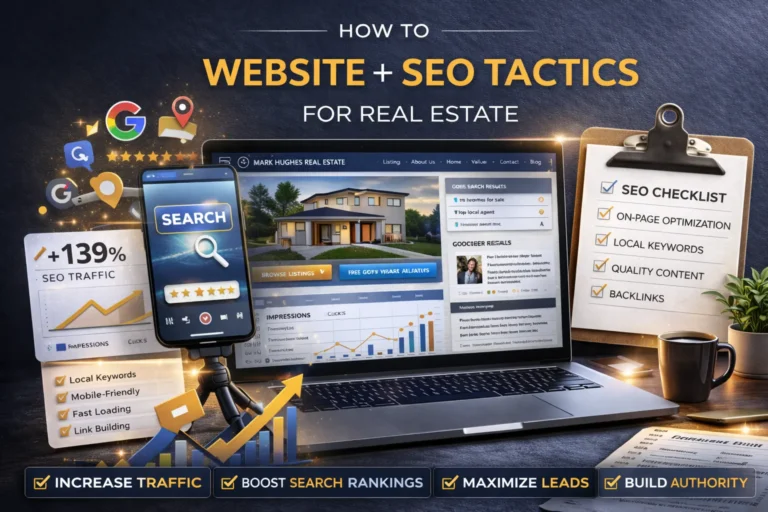
For website-level SEO tactics that complement AI search optimization, read our website and SEO guide.
The 7-Step AI Visibility Playbook for Real Estate Agents
Here is the practical framework. These seven steps are ordered by impact and difficulty, starting with the actions that produce the fastest results.
Step 1: Optimize Your Google Business Profile
AI systems reference Google Business Profile data heavily when generating local recommendations. Your GBP is often the single most important factor in whether AI mentions you when someone asks about agents in your area.
Ensure your profile is 100% complete: all categories selected, services listed with descriptions, business hours accurate, photos current (and uploaded regularly), and your business description written in clear, factual language that describes who you serve and where you operate.
Post to your GBP weekly. AI systems track freshness and activity. An agent who posts market updates weekly signals active local expertise. An agent whose last post was six months ago signals inactivity.
Reviews are critical. Both the quantity and recency of your reviews influence how AI systems evaluate your authority. Ask every client for a review after closing, and respond to every review you receive, positive or negative.
Step 2: Write Content That Answers Specific Questions
AI systems retrieve content that directly answers questions. Structure every blog post and page around the actual questions buyers and sellers ask.
Use question-based headings: “How Long Does It Take to Sell a Home in [City]?” rather than “Market Timing Tips.” Then answer that question directly in the first two sentences of the section before expanding with data and context.
This format mirrors how AI retrieves information. The system scans your heading, reads the first paragraph, and decides whether your content is a reliable answer. If you bury the answer five paragraphs deep behind an introduction, AI may never find it.
Step 3: Publish Hyperlocal Content Regularly
Generic content gets lost in a sea of national real estate blogs. Hyperlocal content has far less competition and is exactly what AI needs when answering location-specific questions.
Create neighborhood guides, monthly market updates by zip code, local event roundups, and area comparison content. Include specific data points: median sale prices, days on market, inventory levels, school ratings, and commute times. This kind of specific, verifiable information is what AI systems prefer to cite.
Aim to publish at least one hyperlocal piece per month. Over a year, you build a library of 12 or more location-specific articles that collectively establish you as the authoritative voice for your market.
Step 4: Add Structured Data (Schema Markup)
Schema markup helps AI systems understand the context of your content. It is code added to your website that tells AI “this page is an article about real estate in Baltimore” or “this section answers a frequently asked question about home selling.”
The most important schema types for real estate agents are:
LocalBusiness schema on your homepage and contact page, with your name, address, phone number, service area, and business type clearly defined.
FAQ schema on pages with question-and-answer content. If you use Yoast SEO Premium, the Yoast FAQ block generates this automatically.
Article schema on blog posts, which Yoast also handles automatically when you mark posts as articles and fill in the metadata.
Step 5: Maintain Consistent Information Across the Web
AI systems cross-reference your information across multiple sources to verify identity and authority. If your name, address, and phone number (NAP) differ between your website, Google Business Profile, Zillow profile, Realtor.com, and social media accounts, AI has less confidence in recommending you.
Audit your presence across all platforms and ensure consistency. The same business name, the same phone number, the same address format everywhere.
Step 6: Get Mentioned on Authoritative Sites
AI models give more weight to agents who are referenced on trusted platforms. Being mentioned in local news articles, guest posting on real estate industry blogs, appearing in community organization features, and maintaining active profiles on major real estate platforms all contribute to your AI visibility.
This is similar to traditional link building, but with a key difference: AI does not just look at links. It looks at mentions. Your name appearing in a local business journal article, even without a link to your website, still registers as an authority signal.
Step 7: Test Your AI Visibility
The simplest way to measure your progress is to ask the AI yourself. Open ChatGPT, Claude, or Perplexity and ask questions like:
“Who are the best real estate agents in [your city]?”
“What should I look for when hiring a listing agent in [your area]?”
“What is the real estate market like in [your neighborhood] right now?”
See if you appear. See who does appear. Analyze what those agents or sources are doing differently. This is competitive intelligence that most agents never bother to gather.
The AI Visibility Playbook at a Glance
- Optimize Google Business Profile — Complete, active, reviews fresh, posts weekly
- Answer Specific Questions — Question headings, direct answers in first 2 sentences
- Publish Hyperlocal Content — Neighborhood guides, market updates by zip code, local data
- Add Schema Markup — LocalBusiness, FAQ, Article schema via Yoast
- Maintain NAP Consistency — Same name, address, phone across every platform
- Get Mentioned on Authoritative Sites — Local media, industry blogs, professional directories
- Test Your AI Visibility — Ask ChatGPT/Claude about agents in your area, track results
For the implementation checklist that covers GEO and AEO specifically, see our GEO/AEO checklist.
What AI Systems Actually Look For
Based on how current AI models process and retrieve content, here are the specific signals that influence whether your content gets cited.
Declarative, factual statements. AI prefers “The median home price in Towson, MD was $425,000 in Q1 2026, up 3.2% from Q1 2025” over “Prices are going up! Don’t miss out!” The first is citeable. The second is marketing noise.
Structured formatting. Clear headings, short paragraphs, lists when appropriate, and FAQ sections all make content easier for AI to parse and retrieve. Walls of text are harder for AI to extract useful information from.
Recency. An Ahrefs study of 17 million citations found that AI-surfaced URLs average 1,064 days old compared to 1,432 days for traditional search results. This 25.7% freshness advantage means newer content has a better chance of being cited. Regular publishing gives you an edge.
Entity clarity. AI needs to clearly understand who you are, where you operate, and what you specialize in. If your website mentions six different cities, three different business names, and has no clear “about” information, AI systems struggle to categorize you as an authority for any specific location.
Third-party validation. Mentions on other websites, review platforms, professional directories, and local media all reinforce your authority in the eyes of AI systems. This is why a strong Google Business Profile with consistent reviews is so valuable for AI visibility.
Common Mistakes Agents Make with AI Search
Writing for keywords instead of answers. Stuffing keywords into headings and content worked for traditional SEO. AI systems look for content that genuinely answers a question, not content that repeats a phrase 15 times.
Ignoring their Google Business Profile. Many agents have an incomplete or outdated GBP and wonder why AI never mentions them. Your GBP is likely the first place AI systems look when evaluating local agents.
Creating generic national content. An article titled “5 Tips for Selling Your Home” competes with millions of identical articles. An article titled “Selling Your Home in Parkville, MD: What to Expect in 2026” competes with almost nobody.
Waiting for perfect tools. Some agents want to wait until AI visibility tracking tools mature before investing in AI search optimization. By the time those tools are mainstream, your competitors will already be established in AI recommendations. Start now with the basics.
Treating this as separate from regular marketing. AI search optimization is not a separate activity. It is a lens you apply to everything you are already doing: writing blog posts, updating your GBP, asking for reviews, and maintaining your online presence. The work overlaps heavily with good SEO and good content marketing.
For a deeper dive into AI tools and how to use them across your entire business, read our complete AI guide for real estate agents.
How Does Your GBP Score?
Your Google Business Profile is the foundation of AI visibility. LeadsFlow Kit’s free AI-powered audit scores your GBP across 7 critical categories and shows you exactly what to fix.
For the step-by-step implementation checklist, see our GEO and AEO checklist.
Frequently Asked Questions
What is the difference between SEO and AI search optimization?
Traditional SEO focuses on ranking your web pages in Google search results so people click through to your site. AI search optimization focuses on getting your content cited and referenced by AI assistants like ChatGPT, Claude, and Google’s AI Overview when they generate answers to user questions. Both matter, and many of the tactics overlap, but AI optimization places more emphasis on structured answers, factual content, and entity clarity than traditional keyword optimization.
Do I need to optimize for ChatGPT and Google AI separately?
The core principles are the same across all AI platforms: write clear, factual, well-structured content with strong local authority signals. You do not need separate strategies for each AI system. If your content is well-optimized for one, it will generally perform well across all of them. The main difference is that Google’s AI Overview draws heavily from sites that already rank well in traditional search, so maintaining your SEO fundamentals gives you an advantage there.
How long does it take to start appearing in AI recommendations?
There is no fixed timeline, but agents who consistently publish hyperlocal content, maintain an active Google Business Profile, and build reviews typically begin seeing AI citations within 3 to 6 months. AI systems update their knowledge regularly, and newer content has a documented freshness advantage over older material. The sooner you start, the sooner you build the cumulative authority that AI systems need to recommend you confidently.
Can I measure whether AI is recommending me?
Currently, the simplest method is to ask AI tools directly. Search for agents in your area using ChatGPT, Claude, and Perplexity and see whether you appear. You can also monitor referral traffic in Google Analytics from AI platforms (look for traffic from chat.openai.com, perplexity.ai, and similar domains). Dedicated AI visibility tracking tools are emerging but still maturing. For now, manual testing combined with traffic monitoring gives you a working picture.
Is AI search optimization relevant for agents in small markets?
Small markets may actually benefit more from AI search optimization because there is less competition for AI citations. In a major metro area, AI has hundreds of agents to choose from. In a smaller market, being the only agent who publishes consistent hyperlocal content with proper schema markup can make you the default recommendation. The same principles apply regardless of market size.



 English
 Spanish