
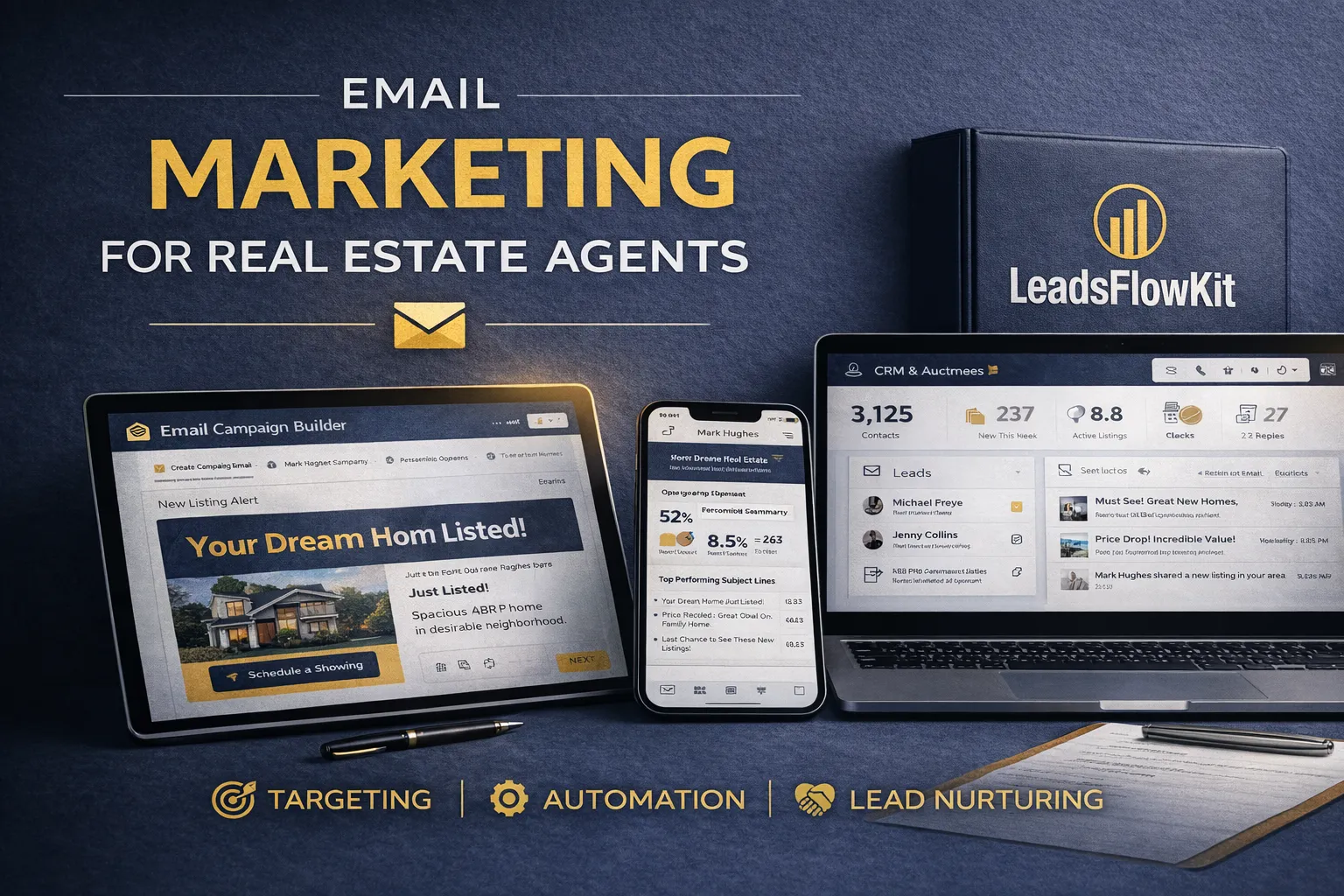
Email Marketing for Real Estate Agents
Email marketing remains the highest-ROI channel available to real estate agents. The average return is $36 for every $1 spent, which outperforms social media, paid ads, and direct mail by a significant margin. Yet most agents either do not email their database at all or send the kind of mass-produced templates that get deleted without being read.
The difference between email that generates business and email that gets ignored comes down to three things: relevance, consistency, and a personal touch. Agents who email their database monthly with genuine market insights, personal updates, and clear value generate 15 to 20 referral and repeat transactions annually from SOI alone. Agents who blast generic templates or only email when they need something generate resentment.
This guide covers the email types that work, the sequences that convert, the metrics that matter, and how to build an email system that runs consistently without consuming your week.
The 5 Email Types Every Agent Needs
Not every email serves the same purpose. A complete email marketing system uses five distinct email types, each designed for a different stage of the client relationship.
The 5 Email Types and When to Use Them
- Market Update: Monthly to full database, 35-45% open rate
- Lead Nurture: Automated sequence for new leads, 5-touch minimum
- Personal: 1-to-1 check-ins for top contacts, highest conversion
- Milestone: Anniversaries, birthdays, holidays, builds loyalty
- Re-Engage: Win-back for cold contacts, quarterly
Key insight: Emails from a personal address (your name) get 35-45% open rates. Branded newsletter templates average 15-20%. Send from you, not your brand.
Type 1: Monthly Market Update
This is the backbone of your email strategy. A monthly email to your full database with local market data, a brief analysis of what the numbers mean, and a personal note. This is not a listing blast. It is a market briefing from a trusted local expert.
Keep it under 500 words. Include 2 to 3 key stats for your area (median price, days on market, inventory). Add one featured listing or recent sale. Close with a personal sentence or two about what you are seeing in the market or what is happening in your community.
The critical detail: send it from your personal email address, not a branded template. Emails that come from “Robert at LeadsFlow Kit” get opened at 35% to 45%. Emails from “LeadsFlow Kit Newsletter” get opened at 15% to 20%. People open emails from people they know.
Type 2: Lead Nurture Sequence
When a new lead enters your pipeline, whether from a website form, open house sign-in, or social media inquiry, they should automatically receive a sequence of follow-up emails over the first 30 days.
The sequence should include at minimum 5 touches: an immediate personal introduction (within 1 hour), a value-add email on day 3, a market insight on day 7, a soft ask for a phone call on day 14, and a check-in on day 30. Each email should be under 150 words and feel personal, not automated.
For the complete follow-up framework including email, text, and phone touchpoints, read our follow-up systems guide.
Type 3: Personal Check-In
These are one-to-one emails to your top 50 contacts. They are not automated. They are genuine, individual messages that reference something specific about the person: their home, their family, their business, or a shared experience.
“Hey [Name], I was driving through your neighborhood last week and noticed the new coffee shop that opened on Main Street. Have you tried it yet? By the way, homes in your area have appreciated about 8% since you bought. If you ever want an updated value, just let me know. Hope the family is doing well.”
These emails convert at the highest rate of any type because they build genuine relationship equity. Aim to send 10 to 15 per month to different contacts in your sphere.
Type 4: Milestone Emails
Purchase anniversaries, birthdays, and holidays are natural touch points. A brief, genuine note on the anniversary of a client’s home purchase (“It has been one year since you closed on [address]. How are you enjoying it?”) keeps you top of mind without being salesy.
These can be partially automated through your CRM by setting date-triggered reminders, but the message itself should feel personal.
Type 5: Re-Engagement Emails
For contacts you have not communicated with in 6 or more months, a re-engagement email acknowledges the gap and re-establishes the relationship. Keep it honest: “It has been a while since we connected, and I wanted to check in.” Include a brief market update for their area and a genuine offer to help if they have any real estate questions.
For how to fit email marketing into a time-efficient monthly routine, read our 4-hour marketing system.
Email Metrics That Matter
Track these numbers monthly to understand whether your email strategy is working.
Open rate: The percentage of recipients who open your email. For real estate, 35% to 45% is excellent for personal-style emails. Below 20% suggests your subject lines need work or your list needs cleaning.
Click rate: The percentage who click a link in your email. For market updates, 5% to 10% is strong. If you are below 3%, your content may not be relevant enough or your calls to action may not be clear.
Reply rate: The percentage who reply directly. This is the most valuable metric because replies indicate genuine engagement. Personal check-ins should generate a 15% to 25% reply rate.
Unsubscribe rate: Keep this below 0.5% per email. Higher rates suggest you are emailing too frequently, your content is not relevant, or your list includes people who did not expect to hear from you.
Building Your Email List the Right Way
Your email list is only as valuable as the relationships behind it. Here is how to build a list that actually converts.
Start with your SOI. Export contacts from your phone, email, and social media. Anyone who knows you well enough to recognize your name belongs on your list. Your initial goal is 200 or more contacts.
Add every new lead. Open house visitors, website form submissions, social media inquiries, and referral introductions all go into your database immediately with the source tagged.
Use lead magnets for organic growth. A free GBP audit, a neighborhood guide download, or a home valuation tool on your website captures email addresses from people who are actively interested in real estate in your area.
Never buy email lists. Purchased lists contain contacts who do not know you, did not ask to hear from you, and will mark your emails as spam. This damages your sender reputation and can get your email address blacklisted.
Clean your list quarterly. Remove bounced addresses, unsubscribed contacts, and anyone who has not opened an email in 12 or more months. A smaller, engaged list outperforms a large, inactive one.
For the broader lead generation strategy that feeds your email list, read our lead generation blueprint.
Never Lose Track of a Contact Again
LeadsFlow Kit’s SOI Manager tracks your sphere, reminds you when to follow up, and ensures no relationship goes cold. Pair it with the Lead Pipeline to see every contact’s journey.
Frequently Asked Questions
How often should a real estate agent email their database?
Once per month is the minimum for maintaining visibility and trust with your full database. Top-producing agents email monthly to their full list and send additional personal check-ins to their top 50 contacts on a rotating basis. Emailing more than twice per month to your full list risks higher unsubscribe rates unless you are providing genuinely valuable content each time.
What is the best email platform for real estate agents?
The best platform is one you will actually use consistently. For agents starting out, Mailchimp or MailerLite offer free tiers that handle up to 500 to 1,000 contacts. For agents who want CRM integration and automation, platforms that combine contact management with email marketing reduce the friction of maintaining multiple tools.
Should I use branded email templates or plain text?
For your monthly market update, a clean, minimal template with your name and photo is fine. For personal check-ins and follow-up sequences, use plain text that looks like a regular email from a real person. Plain text emails consistently outperform heavily designed templates in open rates, click rates, and reply rates for real estate agents.
What subject lines get the best open rates?
Subject lines that reference your local market perform best: “[City] Market Update: What Changed in [Month]” or “Your Neighborhood Just Hit a New Record.” Avoid all caps, excessive punctuation, and clickbait. Curiosity-driven subject lines that promise specific local information outperform generic lines like “Monthly Newsletter” or “Check Out These Listings.”
How do I re-engage contacts who stopped opening my emails?
Send a brief, honest re-engagement email: “I noticed we have not connected in a while. Here is what is happening in your market right now: [1-2 key stats]. If real estate is not on your radar, no worries. But if you have any questions about your home’s current value or the market, I am always here.” Give them a clear reason to re-engage and an easy way to reply.



 English
 Spanish