
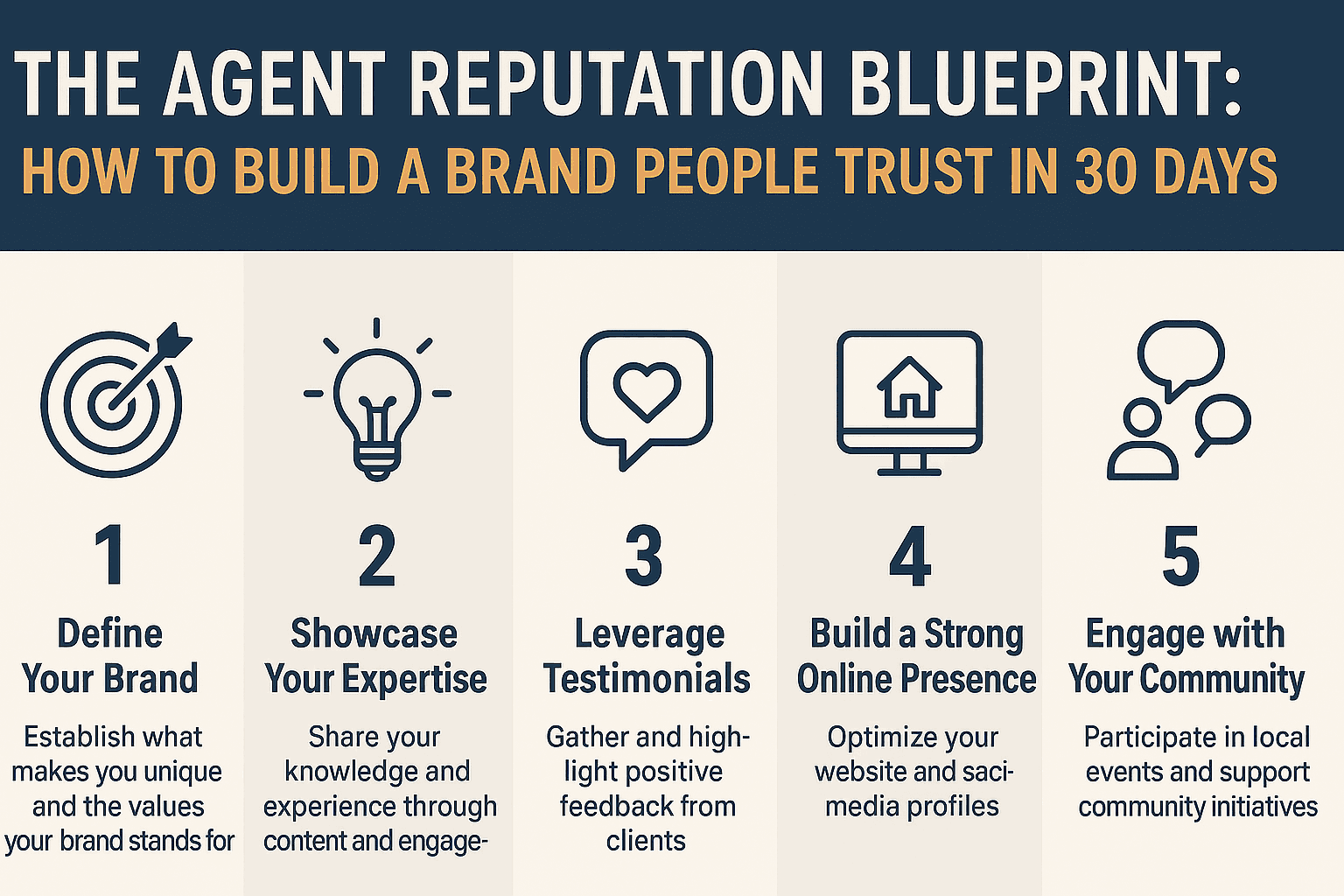
The Agent Reputation Blueprint: How to Build a Brand People Trust
In real estate, people do not hire the most talented agent. They hire the agent they trust. Trust determines who gets the call, who gets the listing appointment, and who gets the referral. And in 2026, trust is built long before the first conversation happens.
Buyers and sellers research agents online before making contact. They read reviews, scan social media profiles, check Google Business Profiles, and quietly decide whether someone feels credible. According to NAR data, 35% of sellers said the agent’s reputation was the most important factor in their hiring decision. Among buyers, 88% rated their agent as the most useful information source during the search process.
The agents who win consistently are not the ones with the biggest ad budgets. They are the ones who have built a recognizable, trustworthy brand in their local market. This blueprint shows you how to build that brand in 30 days using a structured, repeatable system.
What Reputation Actually Means in Real Estate
Reputation is not your logo. It is not your headshot. It is not your tagline. Reputation is the story people tell themselves about you when you are not in the room.
For real estate agents, reputation answers five questions that potential clients are silently asking:
Does this agent know what they are doing? Do they understand my specific market? Can I trust them with one of the biggest financial decisions of my life? Do they seem approachable and responsive? Do they show up consistently?
Everything you post, say, share, and publish either strengthens or weakens the answers to those questions. A strong reputation is not built through one viral post or one great transaction. It is built through hundreds of small, consistent signals that accumulate over time.
The 5 Pillars of Agent Reputation
A trustworthy agent brand rests on five pillars. Each one contributes a different dimension of credibility, and all five need to be active for the brand to feel complete.
The 5 Pillars of Agent Reputation
- Expertise — Market knowledge shown through content
- Social Proof — Reviews, testimonials, closing stories
- Visibility — Consistent presence online and locally
- Personality — Authentic, relatable, human connection
- Discoverability — GBP, SEO, AEO, AI search visibility
All five pillars must be active. A strong reputation with zero discoverability still means no leads.
Pillar 1: Expertise
Demonstrate your knowledge through content, not claims. A blog post with real market data proves expertise more effectively than a social media bio that says “top producer.” Share neighborhood insights, pricing analysis, market trends, and buying or selling guides that show you understand the local landscape at a level your competitors do not.
Pillar 2: Social Proof
What other people say about you is more persuasive than anything you say about yourself. Reviews on Google, Zillow, and Facebook carry the most weight. Client testimonials, closing day photos, and “just sold” stories all contribute. Aim to build a system where every transaction generates at least one review and one shareable piece of content.
Pillar 3: Visibility
You cannot build a reputation if nobody sees you. Consistent posting on social media, regular blog publishing, active participation in local community events, and a current Google Business Profile all contribute to staying visible. Consistency is more important than volume. Three posts per week, every week, beats daily posting for two months followed by silence.
Pillar 4: Personality
People hire people, not brands. Letting your personality come through in your content makes you relatable and memorable. Share behind-the-scenes moments, your perspective on the market, personal milestones, and the occasional lighter content that reminds people you are a real person. This is what differentiates you from agents who post identical market templates.
Pillar 5: Discoverability
A strong reputation means nothing if potential clients cannot find you. Your Google Business Profile, website SEO, AI search optimization, and social media presence all determine whether someone searching for an agent in your area will encounter your name. Read our AI search optimization guide and GEO/AEO checklist for the specific steps.
The 30-Day Reputation Building Plan
Week 1: Audit and Fix Your Foundation
Day 1: Run a Google Business Profile audit. Score yourself across completeness, photos, reviews, posts, and accuracy. Fix any gaps immediately. If you want an objective score, use the free GBP audit tool to get a 7-category breakdown.
Day 2: Audit your social media profiles. Ensure your bio, headshot, and contact information are consistent across all platforms. Remove any outdated information or inactive accounts that could confuse potential clients.
Day 3: Google yourself. Search your name, your name plus your city, and “real estate agent [your city].” See what appears. Note what is missing, what is outdated, and what competitors are doing better.
Day 4-5: Write or update your About page. This should clearly communicate who you are, where you work, how long you have been in the business, and what makes your approach valuable. Write it in first person. Make it personal but professional.
Day 6-7: Request reviews from your 3 most recent clients. Send a personal message (not a mass email) with a direct link to your Google review page. Follow up once if they haven’t responded within 3 days.
Week 2: Create Credibility Content
Day 8-9: Publish a market update for your area. Include median sale price, days on market, inventory levels, and year-over-year comparisons. This positions you as someone with genuine market knowledge, not just listings.
Day 10-11: Create a neighborhood spotlight. Choose the neighborhood you know best and write a guide covering schools, restaurants, parks, commute times, housing stock, and price ranges. This is the kind of hyperlocal content that both search engines and AI systems reward.
Day 12-14: Post 3 times on social media using the content mix: one educational post (market stat or tip), one community post (local business feature or neighborhood photo), and one personal brand post (behind the scenes or your real estate story).
Week 3: Build Social Proof
Day 15-17: Reach out to 5 past clients and ask for a testimonial. Not just a review, but a 2-3 sentence quote you can use on your website and social media. Offer to write a draft they can approve if they are busy.
Day 18-19: Create a “client wins” post. Share a recent closing with context: the challenge, how you solved it, and the result. This shows your problem-solving skills in action, not just a “sold” graphic.
Day 20-21: Post a video. Keep it under 60 seconds. Introduce yourself, share a quick market insight, or walk through a listing. Video builds trust faster than any other content format because people can see your face, hear your voice, and assess your credibility in real time.
Week 4: Expand and Sustain
Day 22-24: Connect with 3 local businesses for cross-promotion. Feature a local coffee shop, contractor, or mortgage broker on your social media. They will likely share the post with their audience, expanding your visibility to new potential clients.
Day 25-26: Post to your Google Business Profile twice this week. Share a market stat and a community event or insight.
Day 27-28: Set up a content calendar for the next 30 days. Plan your posts in advance so consistency becomes automatic rather than dependent on daily motivation.
Day 29-30: Review your progress. Check your GBP insights, social media engagement, and whether any new reviews have come in. Adjust your plan based on what resonated most.
The Review Engine: Your Most Powerful Reputation Asset
Reviews deserve special attention because they are the single most visible trust signal for potential clients and AI systems alike.
Google reviews directly influence both your search ranking and your likelihood of being recommended by AI. A profile with 50 reviews and a 4.9 rating communicates a completely different level of credibility than a profile with 3 reviews and no recent activity.
Make reviews a system, not an afterthought. After every closing, send a thank-you message that includes a direct link to your Google review page. Follow up once after 3 days. Track who has reviewed and who has not.
Respond to every review. Thank positive reviewers by name and mention something specific about their transaction. For negative reviews, respond professionally, acknowledge the concern, and offer to discuss offline. How you handle criticism publicly reveals your character to every potential client who reads it.
Diversify your review platforms. In addition to Google, collect reviews on Zillow, Facebook, and Realtor.com. AI systems cross-reference reviews across platforms, and a presence on multiple sites reinforces your credibility.
For more on how to generate leads from your reputation and brand, read our lead generation blueprint and social media marketing guide.
Your Reputation Starts With Your GBP
Your Google Business Profile is the first thing clients and AI systems check. Get a free 7-category audit and start building a reputation that attracts leads instead of chasing them.
Your reputation is your most powerful lead generation asset. For how to build and manage it systematically, read our agent reputation blueprint.
Frequently Asked Questions
How long does it take to build a reputation as a real estate agent?
You can establish a visible, credible presence in 30 days using a structured approach. However, reputation compounds over time. The agents with the strongest brands have been showing up consistently for months or years. The 30-day plan gets you started with a solid foundation. Sustaining it is what builds lasting authority.
What is the most important factor in building agent reputation?
Consistency. Every other factor, including content quality, review volume, and social media engagement, depends on showing up regularly. An agent who posts three times per week for a year builds dramatically more trust than one who posts daily for one month and then disappears.
How many Google reviews do I need?
There is no magic number, but aim to have more reviews than your direct competitors in your area. At minimum, target 20 to 30 reviews with an average rating of 4.7 or higher. More importantly, ensure reviews are recent. A profile with 50 reviews but none from the past year signals inactivity. Aim for at least 2 new reviews per month.
Should I focus on personal branding or company branding?
Personal branding. In real estate, clients hire the agent, not the brokerage. Your name, face, and expertise are what build trust. Company branding matters for team leaders and brokerages, but individual agents should focus on building their personal reputation first.
How do I build a reputation if I am a new agent with no transactions?
Lead with expertise and community involvement. Publish market data, neighborhood guides, and educational content that demonstrates your knowledge. Volunteer at local events and build relationships in your community. Request character-based testimonials from professional contacts who can vouch for your work ethic and integrity. New agents can build trust through demonstrated knowledge before they have a transaction track record.



 English
 Spanish