
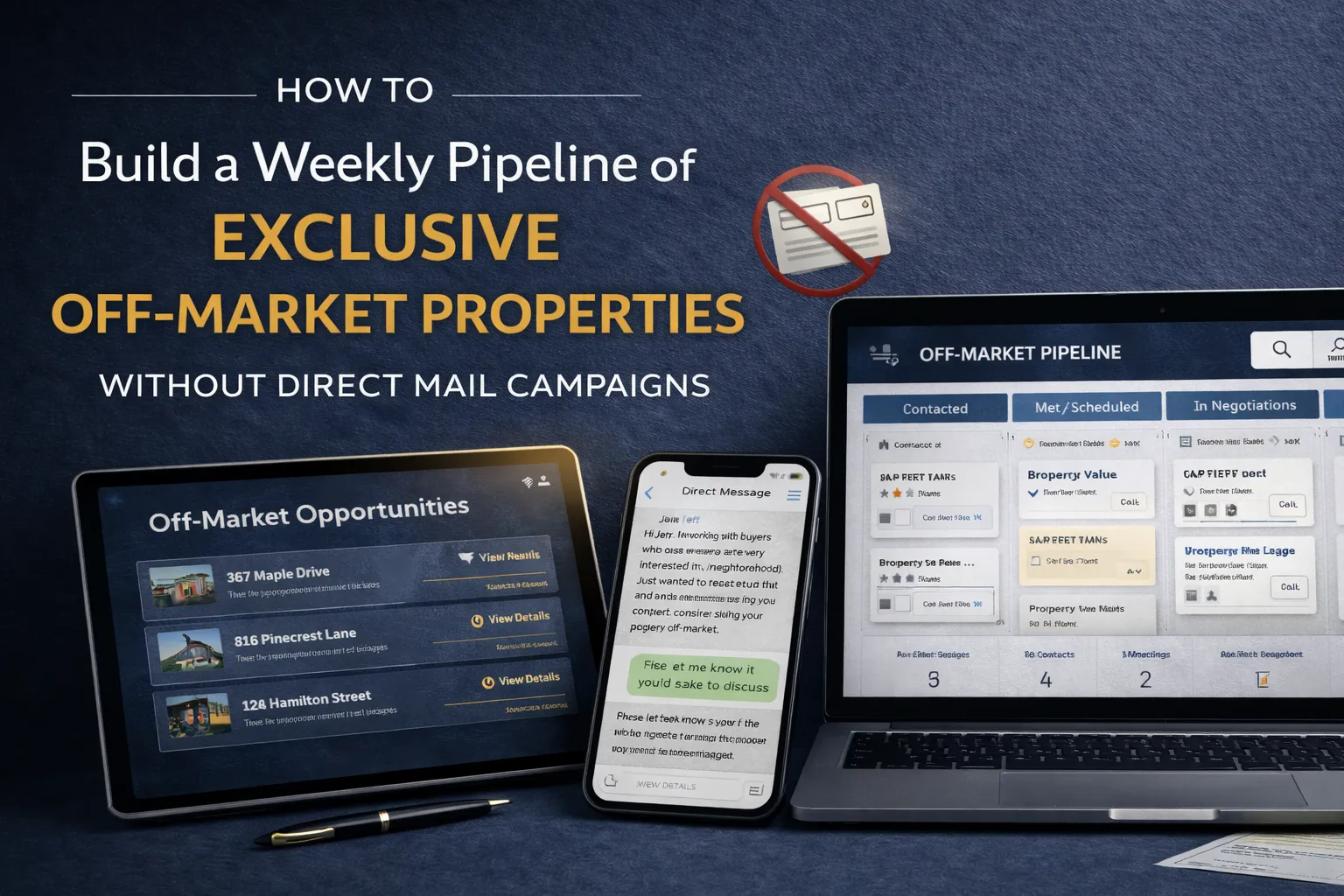
The Off-Market Properties Pipeline: How to Find and Close Deals Before They Hit the MLS
The most competitive agents in any market have one advantage their competitors cannot easily replicate: access to off-market deals. While most agents wait for listings to appear on the MLS and compete with every other agent in the area for the same inventory, agents with an off-market pipeline are bringing deals to their buyers before anyone else knows they exist.
Off-market properties are homes where the owner is willing to sell but has not yet listed publicly. They might be testing the waters with a trusted agent, considering a sale but dreading the showing process, or simply waiting for the right buyer to come along. These deals represent a significant slice of the market. Estimates vary, but industry data suggests that 5% to 15% of residential transactions involve some form of off-market activity.
Building an off-market pipeline is not about secret databases or expensive software. It is about relationships, systems, and consistent effort. This guide covers the sources that produce off-market opportunities, the approach that gets owners to say yes, and the system that keeps your pipeline full month after month.
Why Off-Market Deals Matter
Off-market access benefits both sides of your business. For your buyers, you can offer properties their competing agents cannot show them. For sellers, you can offer a private sale with less disruption, fewer showings, and a faster timeline. For you, off-market deals generate higher loyalty, more referrals, and a reputation as the agent who gets things done that others cannot.
The competitive dynamics are changing too. In tight inventory markets, the agent who can surface off-market opportunities for a frustrated buyer becomes indispensable. In softening markets, the agent who can bring a pre-qualified buyer directly to a hesitant seller closes deals that would otherwise never happen.
The 7 Sources of Off-Market Properties
Off-market deals come from relationships and information advantages, not from a single magic source. The strongest off-market pipelines draw from multiple channels simultaneously.
7 Off-Market Sources Ranked by Reliability
- Your SOI, highest quality
- Agent network
- Door knocking
- Direct mail
- Probate/estate
- Pre-foreclosure
- Social media, lower volume, variable quality
Source 1: Your Sphere of Influence
Your existing network is the most reliable off-market source because it is built on trust. Past clients, friends, family, neighbors, and professional contacts who own homes in your market are all potential off-market sellers. The key is asking the right question at the right time.
During every SOI conversation, weave in a natural version of this question: “Do you know anyone who has been thinking about selling but has not pulled the trigger yet?” This simple question has generated more off-market leads for experienced agents than any other single tactic. People know things about their neighbors, friends, and colleagues that are not public information.
The second approach is the direct ask with homeowners in your network: “I have a buyer who is specifically looking for a home like yours in [neighborhood]. Have you ever thought about what your home might be worth in today’s market?” This works because it is specific, flattering, and low-pressure.
Source 2: Agent-to-Agent Networking
Other agents in your market often have pocket listings, pre-market properties, or sellers who are considering listing but have not committed. Building genuine relationships with agents in your office and in competing brokerages gives you early access to inventory that has not hit the MLS.
Attend office meetings and broker opens. Join local Realtor association committees. Be the agent who consistently brings value to conversations rather than only reaching out when you need something. When you have a serious buyer with specific criteria, circulate a buyer needs email to agents in your network: “I have a pre-approved buyer looking for a 3-bedroom in [area], $400K to $475K range. Do you have anything coming soon?”
Source 3: Door Knocking in Target Neighborhoods
Door knocking in a specific neighborhood where your buyer wants to live is one of the most direct off-market strategies. It works because it demonstrates genuine effort and often reaches homeowners who have thought about selling but never took the first step.
The approach is simple: “I am [name], a local real estate agent. I have a qualified buyer who specifically wants to live in this neighborhood. I am reaching out to homeowners to see if anyone has considered selling. Even if the timing is not right now, I would love to leave my card in case you or anyone you know thinks about it in the future.”
Door knocking works best when you focus on a tight geographic area (50 to 100 homes), return multiple times over several months, and track which homeowners showed any level of interest for follow-up.
Source 4: Targeted Direct Mail
Consistent direct mail to homeowners in your target neighborhoods keeps you top of mind when selling motivation arises. The most effective pieces are not generic postcards. They are personal letters that reference the specific neighborhood, include a relevant market data point, and make a clear offer.
“Homes in [neighborhood] have appreciated [X]% in the past 12 months. If you have thought about selling, I have active buyers looking in your area right now. I would be happy to provide a confidential market analysis of your home at no cost.”
Mail the same neighborhood monthly for at least 6 months before evaluating results. Off-market motivation rarely aligns with the timing of a single mailer.
Source 5: Probate and Estate Situations
Properties in probate or estate situations are often sold off-market because the heirs want a quick, private transaction. Probate filings are public records in most counties and can be found through the county courthouse or online court record systems.
Approach these situations with sensitivity. The family is dealing with a loss, and your outreach should acknowledge that. “I understand this may be a difficult time. If the family is considering selling the property at [address], I can provide a confidential consultation about your options and current market conditions.” Timing matters: reach out 60 to 90 days after the filing when the family has typically begun addressing the estate.
Source 6: Pre-Foreclosure Outreach
Homeowners in pre-foreclosure often benefit from selling the property before it reaches auction, as a traditional sale typically preserves more of their equity. Notice of default filings are public records, and multiple services compile and distribute these lists.
This is a sensitive niche that requires empathy and genuine helpfulness. Position yourself as a resource, not an opportunist: “I noticed a public filing on your property and wanted to reach out confidentially. There may be options available that could protect your financial position. I am happy to discuss the current market value of your home and what a sale might look like, at no cost and no obligation.”
Source 7: Social Media Prospecting
Local Facebook groups, Nextdoor, and community social media accounts occasionally surface off-market opportunities. People post “thinking about selling” or “does anyone know a good agent” before they have committed to a formal listing process.
Monitor these channels regularly but do not treat them as a primary source. The volume is low and the quality varies. When an opportunity does surface, respond quickly with a personal, helpful message rather than a generic sales pitch.
For building the reputation and trust that makes off-market deals possible, read our agent reputation blueprint.
The Off-Market Pitch: What to Say
Approaching a homeowner about selling off-market requires a different conversation than a traditional listing presentation. The seller has not decided to list. They may not have even decided to sell. Your job is to make the conversation easy, low-pressure, and genuinely valuable.
Lead with the buyer, not with you. “I have a qualified buyer who is specifically interested in your neighborhood” is more compelling than “I am a local agent looking for listings.” The existence of a real buyer creates urgency without pressure.
Offer a private market analysis. “I can tell you exactly what your home is worth in today’s market, confidentially, with no obligation to list.” This gives the homeowner valuable information and opens the door to a deeper conversation.
Highlight the advantages of a private sale. No public showings. No open houses. No sign in the yard. No disruption to daily life. No risk of the neighborhood knowing they are selling. For many homeowners, these benefits outweigh the potential of a slightly higher price from full market exposure.
Make the next step easy. “I am happy to stop by for 15 minutes this week, take a look at your home, and give you an honest assessment of what it would sell for. No commitment needed.” The lower the barrier, the higher the conversion.
Building the System: Weekly Off-Market Pipeline Activities
Off-market deal flow does not happen from occasional effort. It requires a consistent weekly system that compounds over time.
Monday: SOI touchpoints. Make 5 calls or send 5 personal messages to people in your sphere. Include the “do you know anyone thinking about selling” question in each conversation.
Tuesday: Agent networking. Reach out to 3 agents in your market with a buyer needs update or a market conversation. Attend any scheduled broker opens or office meetings.
Wednesday: Direct outreach. Send 10 to 20 personalized letters or door knock 15 to 25 homes in a target neighborhood. Rotate between 2 to 3 target areas.
Thursday: Research and tracking. Check probate filings, pre-foreclosure notices, and public records for new opportunities in your target areas. Update your pipeline tracker with any new leads and follow-up notes.
Friday: Follow-up. Contact anyone from the past week or month who showed interest but did not commit. Follow up on market analyses you provided. Check in with pending off-market conversations.
For the complete lead generation system that integrates off-market prospecting with your other lead channels, read our lead generation blueprint. For the follow-up sequences that convert off-market conversations into closed deals, read our follow-up systems guide.
Track Every Deal in Your Pipeline
LeadsFlow Kit’s Lead Pipeline Manager tracks every off-market opportunity from first contact to close. The SOI Manager keeps your sphere relationships warm so the deals keep coming.
For a dedicated lead generation strategy focused on properties before they hit the MLS, read our off-market properties pipeline guide.
Frequently Asked Questions
Are off-market deals legal and ethical?
Yes, off-market transactions are legal. However, NAR’s Clear Cooperation Policy requires that listings be submitted to the MLS within one business day of being marketed to the public. Private exclusive listings (where no public marketing occurs) and office exclusives have specific rules that vary by MLS. Always check your local MLS rules and consult your broker before marketing a property outside the MLS.
How long does it take to build an off-market pipeline?
Expect 3 to 6 months of consistent weekly activity before you see regular off-market deal flow. The first month builds awareness. Months 2 through 3 generate conversations. Months 4 through 6 produce the first closings. Once established, the pipeline becomes self-sustaining as past off-market clients refer new opportunities.
Do I need a buyer before approaching off-market sellers?
Having a real buyer makes the conversation more compelling, but you do not always need one. You can approach homeowners with a market analysis offer or a general “I have active buyers in this area” message. However, the strongest off-market conversations happen when you can say “I have a specific buyer who is pre-approved and looking for a home exactly like yours.”
What is the best way to track off-market leads?
Use your CRM or a dedicated pipeline tracker. For each off-market lead, track: the property address, homeowner name, source of the lead, date of first contact, current status (cold, warm, hot, under contract), follow-up schedule, and any notes from conversations. Review your off-market pipeline weekly and ensure every warm or hot lead has a scheduled next touchpoint.
How do I price an off-market property fairly?
Use the same comparable market analysis process you would for any listing. Pull recent comparable sales, adjust for differences in condition, size, and features, and present the seller with a data-supported price range. Off-market sellers sometimes accept a slightly lower price in exchange for the convenience and privacy of a private sale, but the pricing should still be grounded in market data.






 English
 Spanish