
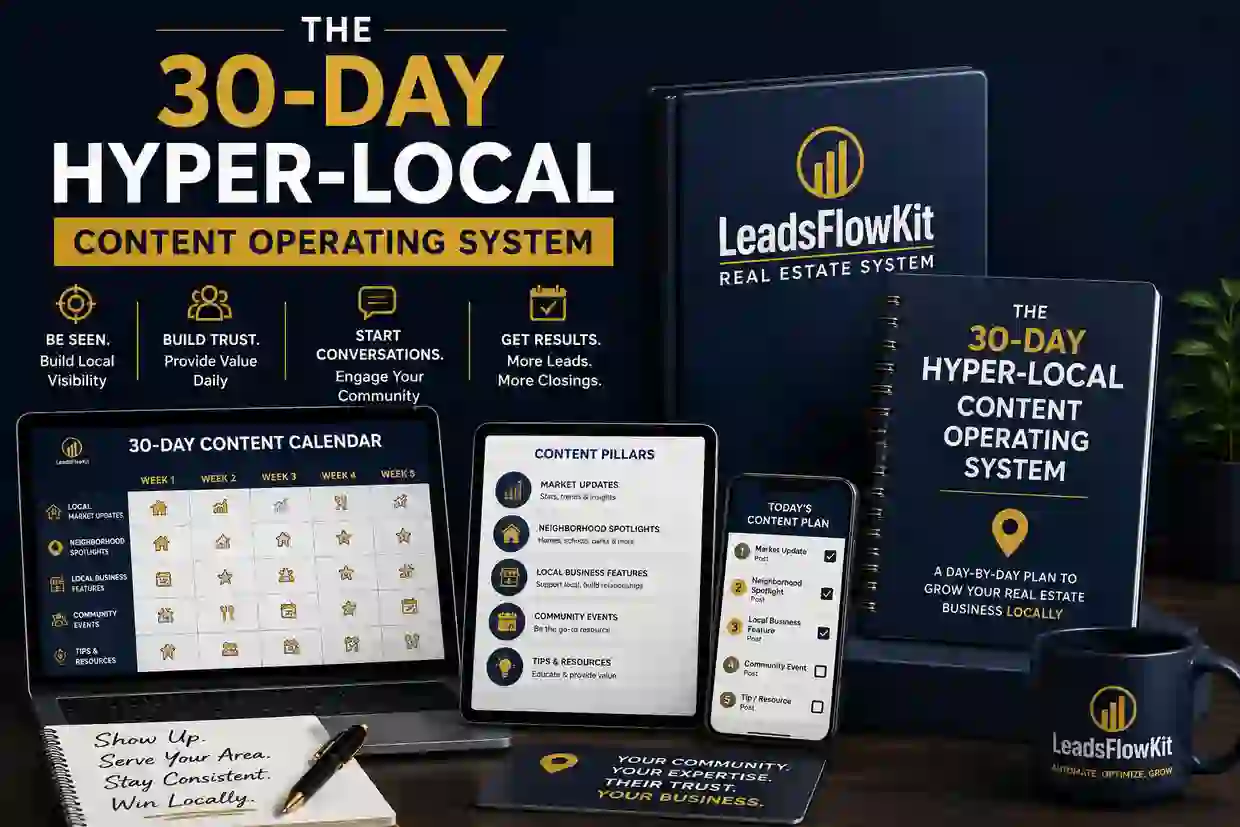
The 30-Day Hyper-Local Content Operating System
The agents who dominate their local market online all have one thing in common: they create content that is so specific to their area that no national blog, portal, or AI tool can replicate it. They are not competing with Zillow for “homes for sale.” They are the definitive source for what it is actually like to live in their neighborhoods.
This is hyperlocal content, and it is the single most effective content strategy for real estate agents who want to own their market online. It works for search engines because the competition is minimal. It works for AI systems because location-specific data is exactly what they need to answer location-specific questions. And it works for your audience because people making the biggest purchase of their lives want information from someone who genuinely knows the area.
This 30-day operating system gives you the exact plan: what to create, where to publish it, and how to turn local content into leads.
Why Hyperlocal Content Wins
Generic real estate content competes with millions of pages. A blog post titled “5 Tips for First-Time Buyers” faces competition from every national real estate brand, every media outlet, and thousands of other agents publishing the same advice.
A blog post titled “First-Time Buyer’s Guide to Parkville, MD: Neighborhoods, Prices, and What to Expect in 2026” competes with almost nobody. The handful of agents in that area who publish regularly have the entire search landscape to themselves.
This applies equally to AI visibility. When someone asks ChatGPT or Google’s AI Overview about a specific neighborhood, the system needs local sources to cite. If you are the only agent in your market publishing consistent, data-rich local content, you become the default recommendation.
For the broader lead generation strategy this content supports, read our lead generation blueprint.
The 30-Day Content Calendar
This system produces 16 pieces of content over 30 days: 12 social media posts, 2 blog articles, 1 email newsletter, and 1 GBP post series (4 weekly posts). All content centers on your local market.
30-Day Hyperlocal Content Map
| Week | Theme | Content Plan |
|---|---|---|
| Week 1 | Market Data | Blog: Market Update Social: Stat graphic Social: What buyers ask Social: Personal insight GBP: Market stat post |
| Week 2 | Community | Blog: Local Business Feature Social: Restaurant rec Social: Event roundup Social: “Did you know” GBP: Community event |
| Week 3 | Lifestyle | Email: Monthly Newsletter Social: Neighborhood walk Social: Park/trail feature Social: Commute tip GBP: Listing/tip |
| Week 4 | Expertise | Review + Plan Next Month Social: Client story Social: Buying/selling tip Social: Review spotlight GBP: Market outlook |
Total: 2 blog posts + 12 social posts + 1 email + 4 GBP posts = 19 content pieces. Production time: about 4 hours if batched (see the 4-Hour Marketing System).
Week 1: Market Data Theme
Blog post: Monthly market update. Pull your local data from MLS: median sale price, days on market, active inventory, and year-over-year change. Write a 1,000-word analysis explaining what these numbers mean for buyers and sellers in your area. Use question-based headings that match what people search for: “How Much Does a Home Cost in [City] Right Now?” and “Is It a Good Time to Sell in [Neighborhood]?”
3 social posts: One graphic highlighting a key stat from your market update. One post answering the most common question buyers in your area ask. One personal insight about what you are seeing in the field.
1 GBP post: Share a key market stat with a brief explanation and a link to your full blog post.
Week 2: Community Theme
Blog post: Local business or community feature. Interview a local business owner, profile a community event, or create a curated guide (“7 Coffee Shops in [Neighborhood] Worth Trying”). This content gets shared by the businesses and organizations you feature, expanding your reach to their audiences.
3 social posts: A restaurant recommendation with a personal photo. A local event roundup for the coming week. A “did you know” fact about your area’s history, growth, or unique character.
1 GBP post: Share a community event or local business recommendation.
Week 3: Lifestyle Theme
Email newsletter: Combine highlights from weeks 1 and 2 into your monthly email. Include 2-3 market stats, one community recommendation, one featured listing, and a personal note. Under 500 words.
3 social posts: A video walking through a neighborhood you serve. A park, trail, or outdoor activity spotlight. A commute or transportation tip for people considering your area.
1 GBP post: Share a listing highlight or a useful local tip.
Week 4: Expertise Theme
Review and plan: Analyze which content from weeks 1-3 got the most engagement, clicks, and responses. Use these insights to plan next month’s content calendar. Identify one topic or format to double down on and one to adjust.
3 social posts: A client success story or “just sold” post. A practical buying or selling tip specific to your market. A review or testimonial spotlight.
1 GBP post: Share a market outlook or prediction for the coming month.
For using AI to draft hyperlocal content efficiently, see our AI tools and prompts guide.
Content Pillars: The Topics That Never Run Dry
Hyperlocal content is sustainable because the source material refreshes naturally. Market data changes monthly. Restaurants open and close. Seasons change. Events happen. New development breaks ground. Here are the content pillars that provide unlimited material.
Market data: Monthly price updates, inventory reports, year-over-year comparisons, seasonal trends, new construction activity.
Community: Local business features, restaurant reviews, event calendars, school information, park and recreation guides, community organization spotlights.
Lifestyle: Neighborhood walkthroughs, commute guides, “best of” lists, seasonal activity guides, family-friendly destination roundups.
Expertise: Buying and selling tips specific to your area, client stories with location context, market predictions, local regulation updates.
For the full social media strategy and content mix breakdown, read our social media marketing guide. For the system that makes this sustainable in just 4 hours per month, read our 4-hour marketing system.
Plan Your Local Content Strategy
LeadsFlow Kit’s Social Media Calendar helps you plan and track your hyperlocal content monthly. See what is performing and double down on what works.
For the exact 30-day content calendar with daily topics and posting schedule, read our hyperlocal content operating system.
Frequently Asked Questions
How local does “hyperlocal” need to be?
As specific as possible. Neighborhood-level is ideal. “Baltimore County” is local. “Towson” is hyperlocal. “The Aigburth neighborhood in Towson” is extremely hyperlocal and faces almost zero competition in search. The more specific your content, the less competition you face and the more relevant it is to people considering that exact area.
What if I serve multiple areas?
Pick 3 to 5 primary areas and rotate your focus. Create a dedicated area page on your website for each one, and rotate your monthly content calendar through them. Over 12 months, each area gets covered 2 to 3 times with fresh content, building a deep library of hyperlocal material across your service territory.
How do I find content ideas for my area every month?
Follow local Facebook groups, neighborhood newsletters, your city’s event calendar, and local news. Visit new restaurants and shops. Attend community events. Drive through your farm area weekly and notice what is changing. The content material is everywhere once you start looking for it with a creator’s eye.
Does hyperlocal content work for AI search optimization?
Hyperlocal content is one of the strongest signals for AI search visibility. When someone asks an AI assistant about a specific neighborhood or city, the system needs location-specific sources to cite. If you are the only agent publishing detailed, data-rich content about your area, you become the default source AI recommends.
Can I use AI to help create hyperlocal content?
AI is excellent for structuring and drafting hyperlocal content, but you must supply the local data, personal observations, and community knowledge. Feed AI your MLS stats, your neighborhood notes, and your personal experiences, then let it organize and polish the writing. The combination of your local expertise and AI efficiency is what makes this system sustainable at 4 hours per month.




 English
 Spanish